Physical Address
304 North Cardinal St.
Dorchester Center, MA 02124
Physical Address
304 North Cardinal St.
Dorchester Center, MA 02124

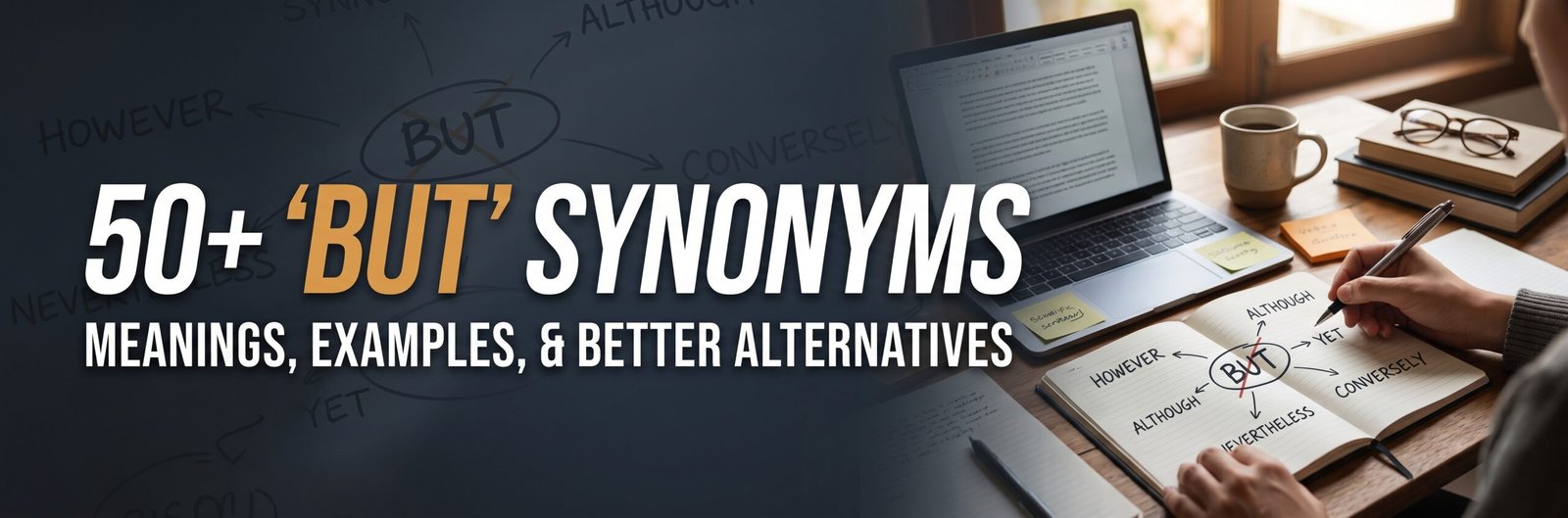
“But” is useful, but using it repeatedly can make your writing sound flat and predictable. A better But Synonym can sharpen your message and create a smoother transition between ideas.
The right choice depends on your sentence. Use “however” in formal writing, “though” in casual conversation, or “yet” when the contrast feels surprising. Words like “although,” “nevertheless,” and “whereas” also serve different purposes.
In this guide, you’ll find clear meanings, practical examples, and helpful usage tips. You’ll learn how each alternative changes your tone, sentence structure, and emphasis. Whether you’re writing an essay, email, report, resume, or social post, these options can help your words sound more natural. Keep reading to choose the right alternative without forcing an awkward replacement.
“But” usually connects two ideas that contrast with each other. The second idea may challenge, limit, or qualify the first one.
For example:
In each sentence, “but” creates a relationship between two thoughts. The first statement remains true, yet the second adds an opposing idea.
“But” can serve several grammatical purposes:
In modern American English, the conjunction is by far the most common use.
No single alternative fits every sentence. Each option changes the tone, emphasis, or grammatical structure slightly.
Here are some of the most useful choices:
For everyday writing, “however,” “yet,” “though,” and “although” usually provide the most natural alternatives.
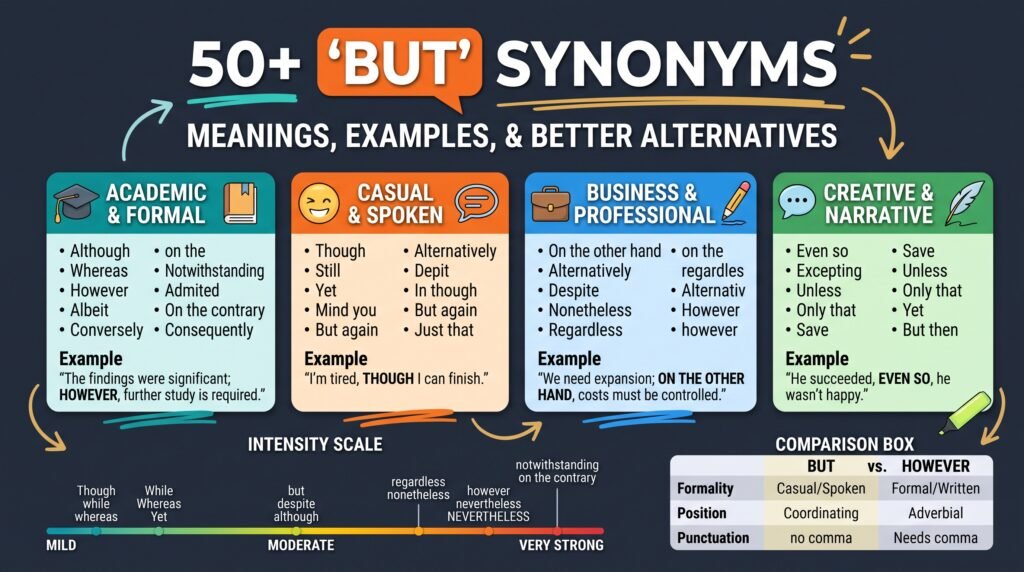
The right word depends on where you’re writing and how you want to sound. A phrase that works in a research paper may feel stiff in a text message.
Use however, nevertheless, or nonetheless in reports, proposals, and formal correspondence.
Example:
The proposal is financially practical; however, it requires additional approval.
These alternatives sound polished without changing the basic meaning.
Academic writing often needs careful qualification rather than a blunt contrast. Although, whereas, nevertheless, and nonetheless work well.
Example:
Although the sample was limited, the findings suggest a meaningful pattern.
Use “although” when you want to make one idea dependent on another. Use “nevertheless” when you want to emphasize that a conclusion remains valid despite a limitation.
For business writing, choose words that sound professional but still feel natural. However, nonetheless, and on the other hand are useful options.
Example:
Sales increased this quarter; nonetheless, operating costs also rose.
When comparing strategies, on the other hand helps present a balanced alternative.
But Synonym But Synonym But Synonym But Synonym But Synonym But Synonym But Synonym But Synonym But Synonym But Synonym But Synonym But Synonym But Synonym But Synonym But Synonym But Synonym But Synonym But Synonym But Synonym But Synonym But Synonym But Synonym But Synonym But Synonym But Synonym But Synonym But Synonym But Synonym But Synonym But Synonym
In everyday speech, though, yet, and still sound comfortable and natural.
Examples:
You don’t need a formal synonym when “but” already sounds clear and natural.
Use yet, still, and even so when you want to add feeling, tension, or persistence.
Examples:
These words do more than connect ideas. They shape the emotional direction of the sentence.
A resume usually works better when it states achievements directly instead of relying on contrast words.
Instead of:
Try:
This structure highlights the achievement rather than drawing attention to a weakness.
The following words and phrases can replace “but,” although they don’t all work in the same grammatical position.
“However” is the most versatile formal synonym for “but.” It often appears after a semicolon or at the beginning of a new sentence.
Example:
The design is attractive; however, it isn’t very practical.
“Yet” suggests that the second idea is unexpected or surprising.
Example:
The instructions were simple, yet several people made mistakes.
“Although” introduces a dependent clause and often begins a sentence.
Example:
Although the deadline was tight, the team completed the project.
“Though” sounds more conversational than “although.” It can also appear at the end of a sentence.
Example:
The restaurant was crowded. The food was excellent, though.
“Nevertheless” means “in spite of that.” It suits formal writing and emphasizes persistence.
Example:
The evidence was incomplete; nevertheless, the committee approved the recommendation.
“Nonetheless” has nearly the same meaning as “nevertheless.” It often sounds slightly more businesslike.
Example:
The process was expensive; nonetheless, it produced reliable results.
“Still” emphasizes that something remains true despite a problem.
Example:
The route was longer. Still, it was safer.
“Whereas” compares two people, things, or situations.
Example:
The first model is affordable, whereas the newer version offers better performance.
“Even so” acknowledges the previous point before introducing a contrast.
Example:
The forecast looked unfavorable. Even so, the organizers continued with the event.
This phrase introduces a different viewpoint, option, or consequence.
Example:
Working remotely saves commuting time. On the other hand, some employees miss face-to-face collaboration.
“Albeit” means “although” or “even though.” It usually introduces a limitation.
Example:
The solution was effective, albeit expensive.
“Notwithstanding” means “despite” or “in spite of.” It sounds highly formal.
Example:
Notwithstanding the delays, the project met its final objective.
This phrase directly points back to a previous statement.
Example:
The instructions were confusing. Despite that, we finished the installation.
This phrase works much like “nevertheless,” though it sounds slightly more conversational.
Example:
The trip was exhausting. In spite of that, we would do it again.
“Conversely” introduces an opposite result or viewpoint.
Example:
Higher prices may reduce demand. Conversely, discounts can increase sales volume.
“Instead” presents a different choice or outcome rather than simple contrast.
Example:
We didn’t take the highway. Instead, we followed the scenic route.
“Except” means “excluding” or “with the exception of.” It cannot replace “but” in every contrast sentence.
Example:
Everyone agreed except Marcus.
“Only” can replace “but” when “but” means “just” or expresses a limitation.
Example:
It was only a minor delay.
“Barring” means “unless something prevents it” or “except for.”
Example:
Barring unexpected problems, construction should finish in June.
“Save” can mean “except,” but it sounds literary or old-fashioned in many modern contexts.
Example:
All save one member supported the proposal.
Before replacing “but,” ask yourself what relationship exists between the two ideas.
Use “however” when the second idea simply differs from the first.
Use “yet” when the second idea feels unexpected.
Use “although” when one idea should function as background information.
These options show that something remains true despite a difficulty.
Use “whereas” when two subjects or categories appear side by side.
“Though” can make a contrast sound less sharp.
“But” and “however” both introduce contrast, but their grammar differs.
“But” is a coordinating conjunction. It can join two independent clauses with a comma.
“However” is a conjunctive adverb. It usually follows a period or semicolon.
Avoid joining two complete sentences with only a comma before “however.”
“Yet” often carries more emphasis than “but.” It suggests an outcome that surprises the reader.
The first sentence states a contrast. The second highlights an unexpected achievement.
“But” joins two equal ideas, while “although” introduces a dependent clause.
Don’t combine them unnecessarily:
“Nevertheless” means “despite that” and sounds more formal. It often emphasizes determination or an outcome that continues despite a problem.
Use “but” for everyday clarity. Choose “nevertheless” when the contrast deserves more weight.
“But” can express many kinds of contrast. “Whereas” specifically compares two different subjects, conditions, or categories.
The second version presents the preferences as a direct comparison.
“Still” suggests continuation despite an obstacle.
The second example emphasizes determination more strongly.
Some phrases with “but” don’t mean simple contrast. Treat them as fixed expressions.
“Nothing but” means “only” or “nothing other than.”
“All but” usually means “almost.”
“Anything but” means “not at all” or “the opposite of.”
“But for” means “without” or “if it weren’t for.”
“But then” introduces a qualification or a new thought.
This expression means no excuses, objections, or negotiation.
Academic and professional writing often benefits from more specific transitions. However, formal words shouldn’t replace “but” automatically.
Use:
Examples:
The best choice depends on sentence structure, not just formality.
Professional emails need clarity and tact. A direct “but” can sometimes sound abrupt, especially after praise.
Instead of:
Try:
These versions keep the message honest while sounding more measured.
Useful phrases include:
Example:
The timeline is ambitious. That said, the team has the experience to meet it.
Your choice may depend on where the contrast appears.
Use:
Example:
However, the final decision requires board approval.
Use:
Example:
The device is compact, yet it performs well.
Use:
Example:
I’m not completely convinced. The idea has potential, though.
“Though” sounds especially natural at the end of casual sentences.
You don’t need to replace every instance of “but.” It’s short, clear, and grammatically useful.
Keep “but” when:
For example:
Replacing these sentences with “nevertheless” or “notwithstanding” would make them sound unnatural.
304 Meaning: What Does 304 Mean in Text, TikTok, Instagram & Internet Slang?
Incorrect:
Better:
Incorrect:
Better:
“Yet” can imply surprise. It may sound excessive when the contrast is ordinary.
“Yet” would work better when the result is genuinely unexpected:
“Notwithstanding” may be grammatically correct, but it can sound stiff in a text message.
Natural:
Unnatural in casual conversation:
“Whereas” compares two subjects. It cannot replace “but” in every sentence.
Replacing every “but” with “however” can create a different kind of repetition. Vary your sentence structure instead.
Try:
“But” signals opposition or qualification. Words such as “and,” “also,” and “furthermore” usually add information instead.
Examples:
These aren’t exact grammatical opposites in every situation. They simply create addition, continuation, or agreement instead of contrast.
TubeHalote Meaning, Review, Features & What You Should Know in 2026
“However” is the most versatile formal synonym, while “nevertheless” and “nonetheless” emphasize persistence despite difficulties.
“Yet” is a simple alternative that adds mild emphasis, while “though” sounds natural in casual conversation.
No. “However” follows different punctuation rules and may change the sentence structure or emphasis.
“Although,” “however,” “nevertheless,” and “whereas” work well, depending on the clause structure and intended relationship.
Use “however,” “that said,” “at the same time,” or “nevertheless” to express contrast politely and professionally.
Usually, yes. “Yet” often highlights an unexpected result, while “but” usually presents neutral contrast.
“Although” sounds more formal and introduces a dependent clause; “though” feels conversational and can end a sentence.
The best but synonym depends on your audience, sentence structure, and intended tone. Use “however” for polished formal writing, “although” for dependent clauses, “yet” for surprising contrast, and “though” for relaxed conversation.
Words such as “nevertheless,” “nonetheless,” “still,” “whereas,” and “even so” add more specific shades of meaning. However, you don’t need to avoid “but” completely. It remains clear, natural, and useful in almost every kind of writing.
Before choosing an alternative, ask what you want the reader to notice: a simple contrast, an unexpected result, a limitation, a comparison, or persistence. That small decision will help you write with greater precision and confidence.