Physical Address
304 North Cardinal St.
Dorchester Center, MA 02124
Physical Address
304 North Cardinal St.
Dorchester Center, MA 02124

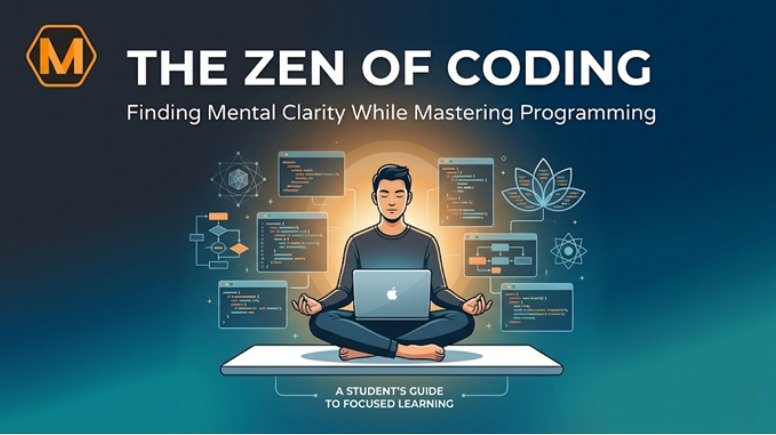
The journey of an undergraduate student in the digital age is often a paradox. You are surrounded by tools designed to make life “easier,” yet the mental load of learning to speak the language of machines is heavier than ever. Programming isn’t just about syntax or semicolons; it is a rigorous exercise in logic that can easily lead to burnout if not approached with a clear mind. To truly master the craft, one must move beyond the “hacker” stereotype of late-night energy drinks and frantic typing. Instead, we must embrace a philosophy of “Zen”—a state of calm, focused awareness that allows for better problem-solving and sustainable growth.
The primary hurdle for many students is the sheer volume of logic required in modern curricula. Whether you are building a desktop application or a complex backend system, the pressure to deliver bug-free code under tight deadlines is immense. During these high-stress periods, it is common to hit a wall where the logic simply stops making sense. Many successful students have found that seeking a structured roadmap or external perspective can break this cycle of frustration. For instance, when the complexities of the .NET ecosystem become overwhelming, utilizing professional c sharp assignment help can provide the necessary bridge between confusing theory and practical execution, allowing a student to regain their mental footing and move forward with confidence.
To find “Zen” in coding, you must first organize your internal and external environments. A cluttered desk often leads to a cluttered mind, and a cluttered mind writes messy code.
Flow is the mental state where you become so immersed in a task that time seems to disappear. In programming, this is where the best logic happens. To achieve this:
Sometimes, the best way to find clarity is to speak. Explaining your code out loud to an inanimate object (like a rubber duck) forces your brain to slow down and evaluate each line of logic. If you can’t explain it simply, you don’t understand it well enough yet.
As you progress through your degree, the languages you encounter will demand different mental frameworks. Understanding these shifts is key to maintaining your composure.
| Feature | C# (Object-Oriented) | JavaScript (Event-Driven) |
| Primary Focus | Structure, Types, and Security | Interactivity and Asynchronicity |
| Mental Model | Building a rigid, reliable blueprint | Managing a flow of constant events |
| Common Hurdle | Understanding Inheritance/Interfaces | Mastering Promises and “Callback Hell” |
| Best For | Enterprise and Game Dev (Unity) | Web Development and Scalable Apps |
While programming is rooted in hard math and logic, there is an undeniable element of intuition involved. This is especially true when working with languages that power the modern web. When you are deep into a project and a script refuses to execute as expected, the frustration can cloud your judgment. In such moments, the expertise provided by MyAssignmentHelp Services through their specialized javascript assignment help serves as a vital academic resource. By seeing how experts handle asynchronous functions or DOM manipulation, students can develop the intuitive “feel” for the language that textbooks often fail to convey. This isn’t just about finishing a task; it’s about seeing the patterns that lead to mastery.
In the world of Zen, there is no “failure,” only feedback. Every “Syntax Error” is a teacher.
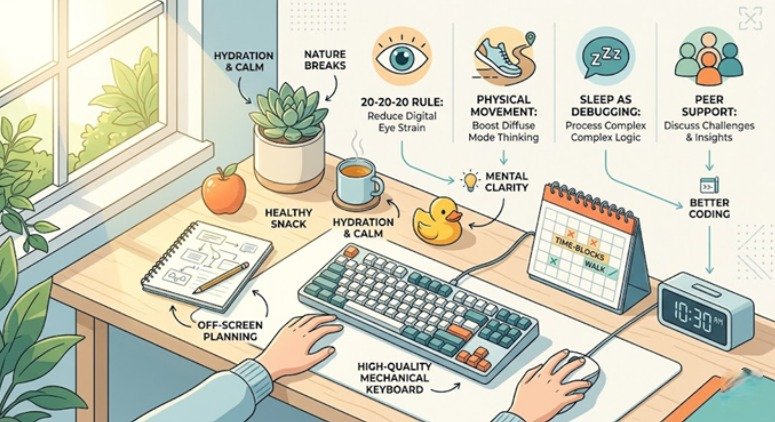
Your brain is a biological processor. If you don’t maintain the hardware, the software (your code) will suffer.
Mastering programming is a marathon, not a sprint. The “Zen” approach is about realizing that you will never know everything—and that is perfectly fine. Technology evolves, languages update, and frameworks change. What remains constant is your ability to stay calm, break problems into smaller pieces, and use the resources available to you. By maintaining your mental clarity, you transform coding from a source of stress into a rewarding craft of endless creation.
Q.1. How do I start learning programming if I feel overwhelmed?
Ans: Start with one language and stick to it for at least three months. Don’t try to learn C#, Java, and Python all at once. Focus on understanding “Computational Thinking” (logic, loops, and variables) which applies to all languages.
Q.2. Is it normal to spend hours on a single bug?
Ans: Yes, even senior developers spend hours, or sometimes days, on a single bug. The key is to take breaks. If you’ve been staring at the same screen for an hour, step away. The solution usually appears when you stop looking for it.
Q.3. Why is my code working but I don’t understand why?
Ans: This is a common “honeymoon phase” problem. Always go back and comment on your code. If it works, try to “break” it intentionally to see how it reacts. This deepens your understanding of the underlying logic.
Q.4. How can I balance my social life with a heavy programming workload?
Ans: Use time-blocking. Dedicate 4 hours of “Deep Work” to coding, and then completely shut down your laptop. Quality of study is much more important than the number of hours spent sitting in front of a screen.
Q.5. Are online resources enough to get a job in tech?
Ans: Online resources are excellent for skills, but a degree or structured academic support helps build the foundational theory that employers look for. Combining your university studies with expert guidance ensures you have both the “how” and the “why” of programming.
Hello, I’m Min Seow. As a Senior Academic Consultant at MyAssignmentHelp Services, I focus on helping undergraduate students navigate the increasingly complex intersection of technology and education.