Physical Address
304 North Cardinal St.
Dorchester Center, MA 02124
Physical Address
304 North Cardinal St.
Dorchester Center, MA 02124

In our fast-paced modern world, many of us feel a persistent sense of disconnection. We scroll through generic daily horoscopes, looking for a sign, a nudge, or a fleeting moment of clarity to make sense of our morning. Yet, these brief, cookie-cutter blurbs often fail to capture the profound nuance of our individual lives. Vedic astrology—a noble tradition spanning thousands of years—offers something fundamentally different. It is not about predicting a static, unchanging future, but about understanding the internal map of our lives to foster genuine, lasting personal growth.
To truly benefit from this ancient wisdom, one must look beyond the superficial desire for entertainment and turn toward the deeper practice of self-reflection. Fortunately, the digital age has made these tools more accessible than ever before, allowing anyone to engage with an ai astrologer free of charge to gain an initial perspective on their unique planetary positions. By moving from a passive, occasional reader of horoscopes to an active participant in understanding one’s own life map, we transition from merely observing life as it happens to consciously and intentionally navigating it.
At the heart of Vedic astrology lies the Kundali, or birth chart. Unlike other systems that often place heavy emphasis on the Sun sign, the Vedic system—historically known as Jyotish, or the “Science of Light”—is deeply rooted in the specific positions of the Moon and the exact time and place of your birth. This map is not a judgment, but a sophisticated snapshot of the cosmic influences at the precise moment you entered the world.
When you seek to understand this map, you are essentially engaging in a form of ancestral self-inquiry. It is a way to identify recurring patterns in your behavior, hidden strengths you may have previously overlooked, and the specific cycles of growth that are unique to your individual trajectory. The goal here is not to find a “lucky day” or to seek external validation, but to understand the “why” behind your personal evolution. By recognizing your inherent tendencies, you gain the power to refine your reactions to life’s inevitable challenges, transforming obstacles into opportunities for self-mastery.
| Concept | Traditional Purpose | Modern Application |
| The Birth Chart (Kundali) | Determining karmic destiny | Identifying inherent strengths & challenges |
| Dasha Periods | Predicting environmental timing | Understanding seasons of internal change |
| Planetary Transits | Observing external forces | Aligning actions with current cosmic energy |
| Self-Reflection | Seeking divine guidance | Cultivating mindfulness and intentionality |
The beauty of contemporary platforms like Astroma is that they have successfully demystified the complex calculations that were once reserved only for the most dedicated scholars. By utilizing a free kundali maker, you can accurately plot the alignment of the heavens at your birth, providing a solid, verifiable foundation for your deeper spiritual exploration.
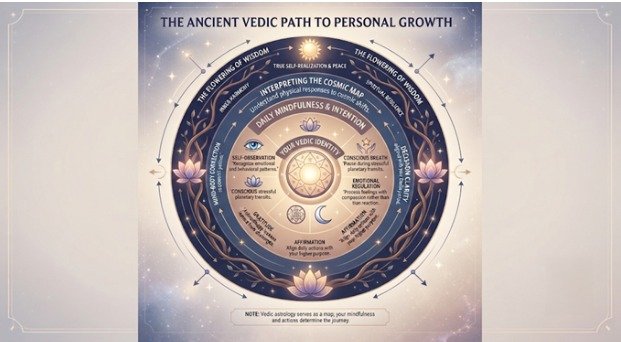
Once you have your chart, the real work begins. It is not enough to simply have the data in front of you; you must learn to interpret it with patience and curiosity. This is where the evolution of technology assists the modern seeker. When you begin to understand the nuances of your chart, you start to see your life as a series of deliberate lessons rather than a string of random, disconnected events. You might notice that certain planetary transitions correlate with periods of intense creativity or times when you felt naturally called to rest and reflect. By recognizing these cycles, you can move through life with more grace, less internal resistance, and a significantly deeper understanding of your own internal landscape. This knowledge acts as a compass, helping you stay true to your purpose even when the world around you feels chaotic.
Personal growth is an active, ongoing process, not a destination. Vedic wisdom suggests that while our chart shows our potential, our actions and our intentions determine our ultimate outcome. This is the critical distinction between fatalism and true empowerment. When you consult these insights, you shouldn’t ask what will happen to you; instead, ask: How can I use this information to be more patient today? How can I better understand my reactions to this specific situation?
Using digital tools should be viewed as an invitation to look inward rather than a way to avoid taking responsibility. These tools are, at their best, mirrors. They do not dictate your future or strip you of your free will; rather, they illuminate the path you are currently walking. By integrating these practices into your daily life—perhaps through morning meditation, mindful journaling, or simply setting a quiet intention based on your findings—you cultivate a profound sense of inner peace that transcends the unpredictability of the outside world. This is the essence of aligning one’s internal state with the larger rhythms of the universe.
As you delve deeper into the study of your chart, you will likely find that your relationship with time, success, and failure begins to shift. You become more observant of your own internal state, noticing how you react to planetary shifts that might have previously caused stress or confusion. This awareness is the first step toward true wisdom.
It is important to remember that astrology is a language, and like any language, it takes time to become fluent. Do not feel pressured to understand every detail immediately. Start by focusing on one or two elements of your chart—perhaps the position of your Moon or the current planetary transit—and observe how these energies manifest in your daily experiences. This slow, methodical approach is much more rewarding than a frantic attempt to find all the answers at once. Ultimately, the journey into Vedic astrology is a journey toward yourself. It is about reclaiming your power, understanding your unique rhythm, and living a life that is more aligned with your authentic nature.
While it does analyze cycles of time, the primary focus of authentic Vedic astrology is to help the individual gain clarity, understand their nature, and make informed, conscious choices to navigate life’s challenges with greater wisdom.
Vedic astrology uses the Sidereal zodiac, which is based on the actual, observed positions of the stars and constellations in the sky, whereas Western astrology typically uses the Tropical zodiac, which is based on the position of the Sun relative to the Earth’s equinoxes.
Yes, but it is far more effective to use them as a tool for long-term reflection. Rather than looking for minute-by-minute predictions, observe how the larger cycles in your chart play out over weeks or months to better understand your growth process.
When used with the right intent, technology serves to make ancient, complex knowledge accessible to a wider audience. As long as the user maintains an attitude of respect and uses the information for personal introspection, digital tools act as a helpful bridge to traditional wisdom.